A certain je ne sais quoi
French lessons. If I didn’t tell you once, I didn’t tell you a thousand times. I am but mad north-north-west ( on Monday or Tuesday ): when the wind is southerly I know my cul from my coude.
The dédaigneux French and the enduring praise of their folly (if you can’t beat them join them)
The parallel texts and cordons sanitaires
Héron haut, beau temps; héron bas, pluie au pas /
Heron to the sea, fair weather there will be; When the heron flies to the hill, the water will soon follow the rill
‘A Discovery of New Worlds’
Aphra Behn, 1688, in the year of England’s Glorious Revolution, piloted a crossing across the Channel surely more important than little Louis Bleriot’s, when she published her translation of de Fontenelle’s Entretiens sur la pluralité des mondes. Behn was one of the first women to make a living from translation, a pioneer in a field wherein the labour of the second sex vastly predominates today. Fontenelle for his part had brought science down from the Latin to the vernacular French, and the entretiens (conversations, lost in translation) were staged as a witty tete-a-tete with a marquise, relocating scientific interest from the cloistered university to the women-led salon.
Civil wars, mud, & glass
Skip back 620 hundred years, alors. The Norman conquest - the three-way battle with the two Harolds…. where William won, 1066, remember? The new French overlords in England continue to pledge fealty to the King in Paris, but soon, mixing tongues and loins abroad, feel themselves to be more English than they do French, and more powerful. Our bard, Shakespeare, looking back, dramatises the ensuing powerplay between these fratricidal French cousins on English soil in the sequence of his plays known as the Henriad, taking up the story at the tail end of the Hundred Year War: In 1399 Richard II, effete (that is to say, too-French) is usurped by Henry IV, the first to take his oath in English. Plagued by the free-for-all he’s unleashed, Henry IV’s deathbed sagesse to his son is thus: busy giddy minds with foreign quarrels. Donc, Henry V, Hal, duly unites the British isles - Welshman, Scot and pauper - with his rousing band of brothers speech and mounts a holy war across the Manche, one with a French legal basis too.
And everyone knows the pear is ripe (la poire est mûre): as the Armagnacs and Burgundians are tearing the French soil apart around him, poor France’s king - Charles le Fol - is just sitting there, stock still for hours, much like a heron, vigilant, but not for the choicest of fish, as per La Fontaine’s fable, but because he thinks he’s made of glass. To be fair Charles is only the most famous of Europe's examples of la folie du verre, also known as the humanist’s or scholar’s melancholy; the black bile of melancholy gets so over-heated by thinking and study as to transform into glass, so the theory went, and it sounds legit to me.
Anyhow, the Fr-English land at Harfleur, the temps has been and continues to be mauvaisement against them: the humidity of the marais/marsh produces a dysentery that wipes out thousands as they march to Agincourt, where the weather now turns, À Rebours, against the French. A perfect storm: newly tilled soil, a torrent on the eve of battle, the over-dressed French in their chivalrous armour get stuck in the mud, mowed down by the English longbow. Meanwhile, Shakespeare has the mad king’s daughter, Katherine, in her chamber, preparing for her treaty transfer to the victor, learning le course and vulgar-sounding English. Marry they do. But determined now on a display of legal legitimacy, the Treaty of Troyes only truly secures Henry V his kingship only once the mad Charles has died. So he hangs around - placeholder, Regent - and sod’s law dies first; outlived by his father-in-law by a mere seven weeks. His baby is crowned though, one who’s also inherited his grandfather’s malady, tant pis. In England, this triggers a power-struggle - the War of the Roses - and in France, the peasant girl Joan, from Lorraine (of the quiche), rallies the original Dauphin (the name for heir), Katherine’s brother. The legendary Jeanne / Joan. Saint to the French, shrew in the Shakespeare, a partisan for Anouilh, proto-protestant for Shaw. De toute façon - not even the heron, could have foretold that she’d sally forth, with her visions, to save the madness of the French for another day! The result: the English lose all their French possessions apart from Calais; Katherine and a Welsh groom Owen Tudor secretly sire the bâtard-line that’ll end the civil war and calm the whole story down for a while in England. Down to Elizabeth I (Katherine’s great-great grandaughter), down to Shakespeare: where the whole sorry episode becomes, at once, a beating drum of English nationalism; the syncopation of the madness of nations.
On se suit? No, pas de problème. We’ve stepped off the bus a stop early to take in the Europe Thomas More of Utopia and his friendship with Erasmus of The Praise of Folly, celui-ci who has Rabelais looking up admiringly at him, trying keep the giddy rave going, before the comedown of Montaigne, whose interiority, internal querying, the que scais-je psychological essay - represents a sidestepping to his own Candide’s garden to remove himself from the tumult of France’s wars of religion. As Frank and Fritzie Manuel put it: ‘Shortly after Utopia was published [1516], the schism in the Church had become open, and the whole intellectual world was turned upside down, but in ways very different from the reforms of King Utopus. By 1520, fanciful innovations ceased to be laughing matters. The playful days were over; one did not toy with utopias while Christendom was being torn asunder.’ Channelling the anxiety over the body politic, which accompanied the chameleon cast of French kings on the throne, wasn’t limited to smoking out Huguenot heretics; the period’s psychomachie - its combat de l'âme - gave rise to a frenzy of actual witch-hunts too.
Against this absolutism - of certainty, of action - Montaigne in his Tower-Library retreat did write: "À tuer les gens, il faut une clarté lumineuse et nette... après tout, c’est mettre ses conjectures à bien haut prix que d’en faire cuire un homme tout vif." In the ugly English it’s rendered thus: "To kill men, we should have sharp and luminous evidence... after all, it is to put a very high price on one's conjectures to have a man roasted alive because of them". Néamoins, France’s gore is England’s gain. Elizabeth I - born the same year as Montaigne, whose long reign parenthesises France’s civil war and five French kings - welcomes the Huguenots, as does Shakespeare, retroactively, in his play ‘The Book of Thomas More’. Shakespeare, moreover, directly cannibalises Montaigne’s Cannibals essay and plants it in Gonzalo’s speech on the “perfect commonwealth” in the Tempest. The whole mood music of Hamlet, in fact, could be said to be Montaigne’s, with action itself on trial.
And as ever, it seems, that as the world looks out, the world looks in; when the internal is intolerable, the boat casts off. America, Europe’s New World, whose Chapter 1 belonged to the Spanish and Portuguese but Chapter 2 to the English and French.
Still, on this side of the pond, the religious contagion passes like a relay baton across la Manche. Here it’s not (just) Catholics vs Protestants as the lethal divide. Or rather, the skepticism, from Luther through to Shakepeare, the protest in the -ism, is the prerogative of each and all. A thousand programmes flourish. And there’s always the Scottish-French alliance of connivance in the wings to stir the pot. As the Sun King dances in France, the English tear themselves apart, banning theatre, demanding worldly action and, without the historical credit its due, decapitating their King in 1649, well in advance of the French. Oh, to think that 377 years later, Charles III is being celebrated by his peasants in Scotland for getting the King of America to bring down whisky tariffs. But maybe that’s the best Hobbes could have asked for in writing his Leviathan in 1651, insisting that the “war of all against all” needs must subordinate itself to the fist of absolute power. Anyway, whether one thanks God or man for the waters, and for the separate states, franchement, were it not for these geo-political rifts, how else would there be for a place of exile. And it must likewise be admitted that it was none other than the Huguenot refugee that developed the publishing trade on these shores. Utopia’s first edition was published in Louvain, its second in Paris; it had been through the import of "maunds" (large baskets) and bales of books that they had arrived on English streets.
To get us back to Behn, we go briefly via the mordant satire of Molière, which she pilfered for her own works, and which Charles II brought back from exile. At the Restoration court, all things French are back a la mode. Still, thankfully, as you’d expect nothing translates smoothly: English comedy, as it heads into the eighteenth century, reacting against the recent puritan reaction, isn’t all that fussed about wanting to police vice through its mockery; indeed, the rakish is somewhat celebrated, and certain stock characters crop up simply to mock the French and the francophile! Racine, with none of the darting back and forth from country to country that we had with Shakespeare, respects the classical unities and confines the drama to the court, specifically to the court of the mind. Untranslateable, Steiner says. These replete, statuesque, French words - gloire, sang, fureur - find flimsy and indifferent equivalents amidst the English proliferation of synonyms, until perhaps we get to Woolf wherein the wisp gains weight.
But before that, in the eurotunnel pipeline, we have Sterne’s Sentimental Journey to seek out the human heart in Calais and Paris only to die in its environs, never getting to Italy. Or Rousseau of the Confessions, seeking sanctuary in London under the protective wing of Hume, there to find himself accusing that: “You brought me to England, apparently to procure me an asylum, but in fact to dishonour me". A hubbub in the European Republic of Letters as they publish and counter-publish their correspondence for public diagnosis. Rousseau - I’m not paranoid if it’s true - oh the brouhaha. It doesn’t stop his Social Contract
Merde, the French connections are endless, and if things are not always the model of neighbouriness, that wouldn’t be remarkable. Torn asunder by such a small stretch of submerged land, though; mutually receptive of each other’s refugees and books; and finding occasional peace in the diplomacy of the marriage-bed: it’s above all the unrelenting rivalry that shapes both countries, the coming empire and the modern world.
We could skip the nineteenth century, what’s there to say. Il m’apparait the century of the historians; writing national history as destiny (Macaulay and Carlyle in England & Michelet in France) or as predictive science (Marx and Comte). Michelet, though, imbuing France with a soul, made the most grandiose and yet hard-to-gainsay of claims:
"Every other history is mutilated; ours alone is complete. Take the history of Italy: the last centuries are missing. Take the history of Germany or England: the first are missing. Take the history of France; with it, you know the world." And more: "France... is the organ of the world, its interpreter; she is the soul of the universe, and it is through her that it speaks... France has done the work of the world." Hat-tip, Edmund Wilson in ‘To the Finland Station’.
Toussaint L’Ouverture opens the nineteenth century gaining for Haiti the title of the first free Black republic - for which it has been punished to this day - using the language of universal rights against its European overlords. Walter Benjamin’s Arcades Project crowns Paris as the capital of the nineteenth century, where the zenith of progress and modernity finds itself already in ruins. In Paris, too, was forged the revolutionary programme of Marx. And ok, there’s Balzac, Flaubert, Sand & Hugo - 1848 a rupture for the quartet, but with Sand en travesti, and sans permission, becoming a minister in the provisional government.
And in the disillusionment, in the wake of the fatal lure of action, while Sand retreats to her beloved Nohant and continues paying the factures en fabricant pastorals, the Flaubert and the Zola opt to watch. The writer's eye, denuded of the I, aspires to become as detached and as cynical as a god or a scientist or a prison system. Flaubert: "L'auteur, dans son œuvre, doit être comme Dieu dans l'univers, présent partout, et visible nulle part." Like God in the universe, present everywhere and visible nowhere. "You produce desolation, and I produce consolation”, Sand continues to carp at him in their letters. Zola - frames the totality as laboratory. Even his childhood friend, Cezanne is subjected to his clinical diagnosis, thereby ending their friendship.
The passive eye of impressionism, regardless, records the fleeting, furnishes the brushstrokes that will paint the coming turmoil. Freud cuts his teeth / fait ses premières armes. From Sand’s key to the city to the terreur of Pitié-Salpêtrière’s confinement of hysterics.
And so, with stones in our pockets … to Woolf, devotee of Racine and Proust, who might not disagree with Michelet, an interlude:
The theory in ‘The Common Reader’ “Examine for a moment an ordinary mind on an ordinary day. The mind receives a myriad impressions — trivial, fantastic, evanescent, or engraved with the sharpness of steel. From all sides they come, an incessant shower of innumerable atoms; and as they fall, as they shape themselves into the life of Monday or Tuesday.”
“MONDAY OR TUESDAY
LAZY and indifferent, shaking space easily from his wings, knowing his way, the heron passes over the church beneath the sky. White and distant, absorbed in itself, endlessly the sky covers and uncovers, moves and remains. A lake? Blot the shores of it out! A mountain? Oh, perfect–the sun gold on its slopes. Down that falls. Ferns then, or white feathers, for ever and ever–
Desiring truth, awaiting it, laboriously distilling a few words, for ever desiring–(a cry starts to the left, another to the right. Wheels strike divergently. Omnibuses conglomerate in conflict)–for ever desiring–(the clock asseverates with twelve distinct strokes that it is mid-day; light sheds gold scales; children swarm)–for ever desiring truth. Red is the dome; coins hang on the trees; smoke trails from the chimneys; bark, shout, cry "Iron for sale"–and truth?
Radiating to a point men's feet and women's feet, black or gold-encrusted–(This foggy weather–Sugar? No, thank you–The commonwealth of the future)–the firelight darting and making the room red, save for the black figures and their bright eyes, while outside a van discharges, Miss Thingummy drinks tea at her desk, and plate-glass preserves fur coats–
Flaunted, leaf-light, drifting at corners, blown across the wheels, silver-splashed, home or not home, gathered, scattered, squandered in separate scales, swept up, down, torn, sunk, assembled–and truth?
Now to recollect by the fireside on the white square of marble. From ivory depths words rising shed their blackness, blossom and penetrate. Fallen the book; in the flame, in the smoke, in the momentary sparks–or now voyaging, the marble square pendant, minarets beneath and the Indian seas, while space rushes blue and stars glint–truth? or now, content with closeness?
Lazy and indifferent the heron returns; the sky veils her stars; then bares them.”
In 1928, Woolf won the Prix Femina–Vie Heureuse for To the Lighthouse which had been translated with alacrity, the award category assigned to honour English writers and to introduce their work in France. Thanks to her journals where she gnashed her teeth (grincait ses dents) we know she derided this award, but she did buy a new car with it “The Singer”, and the animus was not specifically towards the French, turning down honours proffered to her on these shores as “medals for good conduct”. Neither la Vie Heureuse nor Woolf survived the war.
A Tightrope of Hope
When André Breton, fleeing Vichy, docked in Martinique, he found a copy of the journal Tropiques in a bookstore. Of Aimé Césaire, one of the contributors: "Et c'est un noir qui manie la langue française comme il n'est pas aujourd'hui un blanc pour la manier." (And it is a black man who today has hold of the French language in a way no white man can).
Not just the language, but the right aboutissement of the ideas. Suzanne Cesaire, Aimé’s wife sharpens, repurposes the Surrealists’ tools:
"Ainsi, loin d'être un automatisme, loin d'être un renoncement, loin d'être une fuite hors du réel, le surréalisme est pour nous la seule voie possible pour la reconquête de nous-mêmes, la seule manière d'aboutir à une conscience totale de notre situation. Notre surréalisme sera alors la corde raide de notre espoir, le catalyseur, l'étincelle, le levier. Par lui, nous oserons enfin nous regarder en face” /
"Thus, far from being an automatism, far from being a renunciation, far from being an escape from reality, surrealism is for us the only possible path for the reconquest of ourselves, the only way to achieve a total consciousness of our situation. Our surrealism will then be the tightrope of our hope, the catalyst, the spark, the lever. Through it, we will finally dare to look ourselves in the face."
“Our surrealism will then supply them the leaven from their very depths. It will be time to finally transcend the sordid antinomies: Whites-Blacks, Europeans-Africans, civilized-savage… Colonial idiocies will be purified by the welding arc’s blue flame. The mettle of our mettle, our cutting edge of steel, our unique communions––all will be recovered... Surrealism, tightrope of our hope.”
"I am talking about a real Martinican revolution... the internal revolution without which the external revolution is only a snare and a delusion."
Parataxic leaps in her French that fall somewhat flat in the English.
“It is becoming more and more difficult, even senseless, for me to write an official English. And more and more my own language appears to me like a veil that must be torn apart in order to get at the things (or the Nothing-ness) behind it. Grammar and Style. To me they seem to have become as irrelevant as a Victorian bathing suit or the imperturbability of a true gentleman. A mask…Is there any reason why that terrible materiality of the word surface should not be capable of being dissolved?”
This, mes amis, is Samuel Beckett, in his own tongue… justifying writing in French only to translate these works back into English himself. We have Milan Kundera, wanting control of his own translation too, also finding in the adopted language a mode of escape from the culture-bound aspects of himself. There’s Eugene Ionesco, Paul Auster. Ça va sans dire that as white men, their francophonic choices are feats in the struggle of the universal artist.
But for Assia Djebar, 1985
“This language was given to me by the father, like a talisman that allowed me to go out into the light, while my sisters remained in the shadow of the walls. But as I write it today, I feel it becoming a veil—not the fabric that hides the face, but a second skin that separates me from the maternal cry. To speak in French is to move in a space where I am 'unveiled' to the world, yet 'veiled' from my own ancestors.”
- L'Amour, la fantasia (Fantasia: An Algerian Cavalcade)
Then this, with Mahmoud Hussein, the collective pseudonym for two Egyptian-born French intellectuals, Bahgat Elnadi and Adel Rifaat:
“Writing in French allows us to move from the register of emotion and communion to that of reason and analysis. In Arabic, the Quranic word is so saturated with sacredness that the believer is often prevented from looking at it as an object of history. French, for us, is a language of distance and rigour; it allows us to 'think' the text rather than simply 'vibrate' to it. It offers a secular space where the Quran can be approached not just as a liturgical monologue, but as a historical dialogue”
A language, then to hide, to shed, to further alienate or to liberate. To look in the mirror. As Kipling said: "What should they know of England who only England know?"
Et ainsi, to the Pantheon, to AI and to the Americans from Paris
The untranslatability of the French mentality - the language that structures it - and its concomitant obsession with the modes of expression of the confined, the solitary, the socially-maddened mind and its body:
Althusser, the Annales, Artaud, Bachelard, Badiou, Bataille, Baudrillard, de Beauvoir, Blanchot, Braudel, Camus, Cixous, Debord, Deleuze, Derrida, Foucault, Guattari, Irigaray, Kristeva, Lacan, Laplanche, Maurois, Merleau-Ponty, Morin, Ranciere, Ricoeur, Sartre, Serres …. :
From cheap counterfeits, to black mirrors of production, to the singularity of the simulacra; surviving the gift that keeps on giving, pour que tu me regardes encore:
The heroic efforts of Toril Moi, the Norwegian, to bring French feminism to an English world, situates her among a whole bevy of handmaidens to Michelet’s chambers of thought, though it can hardly be said that they’ve succeeded as popularisers. En dépit des best efforts of the professors, the translators, the mocked and mimicked high school French teachers (the most sacrificial of services): the French departments is the dead letters office on campus, and the school curriculum no longer bothers itself with the weather in La Rochelle. The state subsidy of the postage of Livres et Brochures en français à l’étranger is not worthy of the bureaucrats’ cut, when nonchalance does the job. The days of rivalry and emulation seem golden compared.
But more fool the lazy and indifferent English.
Who would constitute the alphabetical who’s who in the Anglo-Saxon world of thought over the last century? It’s interesting that some of the most influential of the intellectual figures - A.J Ayer, Chomsky, Rawls, Russell - sit at the intersection of language, maths and logic - their springboard for social commentary; there’s perhaps a concurrent tendency, attempting to hold onto the coat tails of capitalist technology through the social sciences; descendants of RD Bernal - the last to have any grip. Who “here” outlined the transition of sign to simulacrum that defines our days, sooner or better than Baudrillard - and could we even have had Mark Fisher - who committed suicide as a gigging sessional lecturer - without him. The map that precedes the territory it describes.
The Anglo-saxon world is a world of behaviour, of summary, of repackaged debt sold on. The fictitious self-referential financial bubble of AI and the Language Learning Model can only replicate the American. The American replicates the caricature of the American in downward spirals into the abyss, literally cannibalising the world's resources just to keep the image in circulation; where death means nothing when we’re only kept alive to keep the code running. Our input? our eyes on the screen, seeing or unseeing, and the non-fungible tokens of our duck-lipped gratitude.
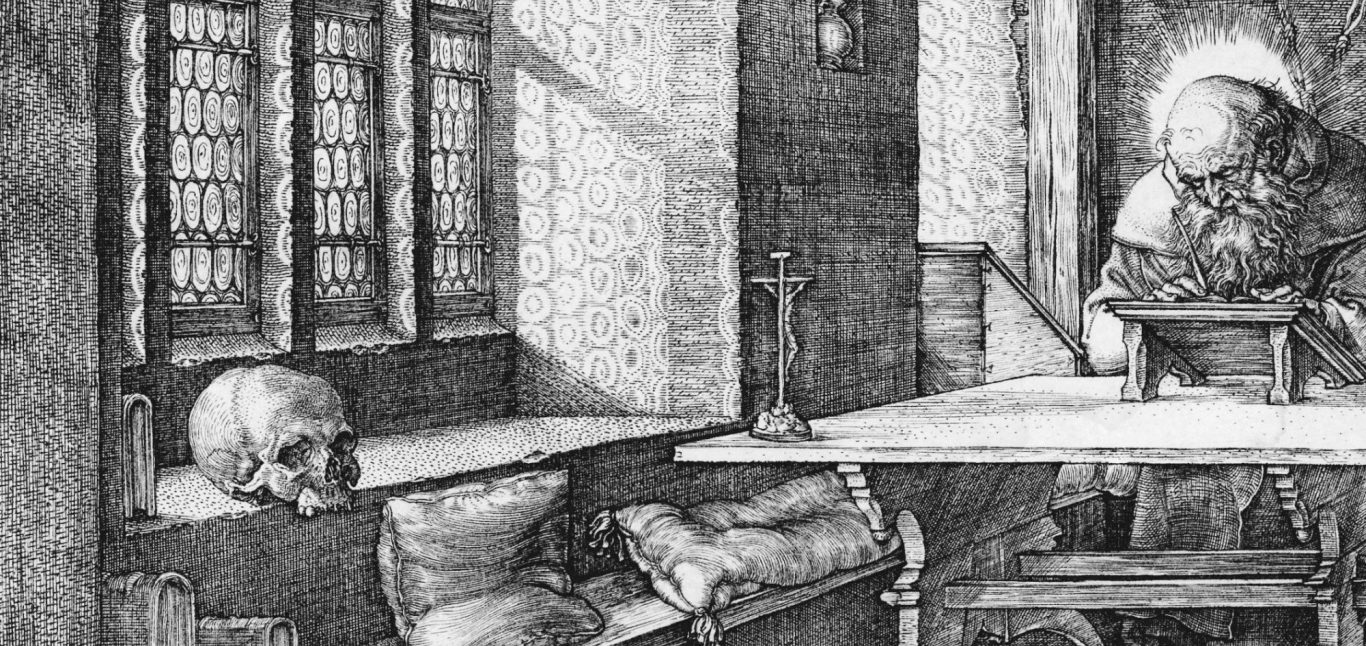
The French have known the néant, the Americans have manufactured and marketed the abyss. A jpeg. of Jerome’s reliquary; his own skull sits next to the indifferent skull on the table of his study, staring back at each other. The now-bored hauntology of the digital librarian, scholar and translator, murmuring prayers for the second coming of the subjunctive
.
A postscript to Sartre, an enterrement de la poupée:
Coucou. Jean-Paul. Je ne t’en veux pas. You confessed a full cognisance of your formative cabotinage in Les Mots. A misspent childhood, nourished by the look of the other, a plaything of a prodigy to grandpère, an enfance without weight, without vocation, days more lived out in words (than what, fixing cars, hunting rabbits?, or today, writing code?) Bullied, harcelé not freed, by the absence of a father - taking out your revenge - your antagonism - in philosophy. It was a good joke, and maybe one befitting the époque. 50,000, a spontaneous rally of students, workers, intellectuals, a photographer falling into your grave. But it seems at your deathbed, you too succumbed - to a messianic judaism, chapeau! - though whether you dropped the mask or adopted another, it’s hard to tell. Did you really never look up and feel in gold-suffused clouds over Paris something fleetingly benign?
Vive le spectacle, envers l’autre, autant qu’il soit possible