1) founders, foundations
1.1 ) C18 Enlightenment: the long century casting its even longer shadow
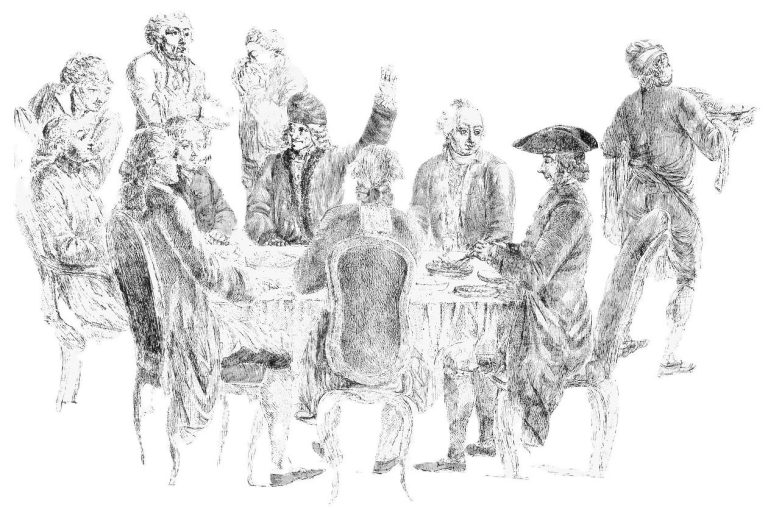
A pivotal century of emulation and revolution in scientific and religious thought, literary expression, and social, economic and industrial organisation. Europe, in the name of Reason, enlarges its envergure across the world's surface and the interior terrain of the human mind. A constantly re-written chapter defined by the political rivalry - and intellectual symbiosis - of Britain and France. Infant America, fed by both, decides to break free. Across Europe, from faculty to faculty, the century differs in its beginnings and endings; it is altogether more studied in France despite Britain's clear political victory by 1815. It's the era where the Republic of Letters courts the Enlightened despots, in music it's bookended by Handel-Bach and Mozart-Haydn. The academy shifts to the centre of the emerging modern state and the foundations are laid for the near-universal literacy achieved the following century. Locke's writings re-weaponises the old blank slate concept to challenge the notion of "innate ideas", implanted by God, the flimsy prop of the Divine Right of Kings to rule. A vision of universal potential crystallises, education is enthroned as arbiter of right. The novel is born, populariser of subjectivity and adventure. Subscription-based libraries spring up; at coffee-houses people in-gather to spread ideas, to rally. Reason sires Progress, its bequest to the century to follow.
1.2 ) 'Utopian Thought in The Western World': a folie à deux festschrift to fantasy
Standing strong, still, today at 912 large luminous pages, 'Utopian Thought in The Western World' was the magnus opus of Frank E. Manuel, historian and philologist, co-written with his wife Fritzie over a quarter of a century, published in 1980, winning several prestigious awards. It features exhilarating psychological portraits of utopian thinkers and weaves an astounding tapestry of Utopian ideas from the renaissance to the 20th century, with their Greek and Biblical wellsprings. Their writing is replete with personality; the variety of approaches taken for each major figure, period or theme has an overarching intelligence that makes their subjective choices and their especial homages intrinsic to the delight of their whole edifice. Turgot & Condorcet form an organic unity; Leibniz, Rousseau and Kant receive the global treatment their minds deserve; the English Civil War and the milieu that produced Erasmus, More & Rabelais come to life as two atmospheres of ideas; Fourier emerges as their clear pet Utopian. The book is a critical celebration of the persistence of the obsessive-utopian propensity in humankind; a tour de force where educational concerns are the centre of the manifestoes; erudition manifest in the glory of their book.

1.3) Go tell it on the mountain:
God's verbs, the nation's Biblia, and the endless exegesis
The most widely distributed book in the world, translated into 6-10 times as many languages as its nearest rival (Le Petit Prince), the enigmatic main character God - Ehyeh Asher Ehyeh - displays a dubious, but always compelling, range of personality traits / mood disorders. He's demanding adulation and awe from an immense supporting cast of actors, mere mirrors, off-shoots of a creation he always was gnarly about. Then Jesus, inscribed in the Greek. A centuries' old education in the intricacies of translation, interpretation and application, with real world and literary ramifications - it's a must read before you give up the ghost. Truly, believe it or not, against the thinness of the street corner pamphleteer, the boredom of the Sunday sermon, the picayune platitudes of promise that Jesus loves you, there's gravitas, there's poetry (alongside pedantry) and passion. Take David and his Psalms: could I have guessed that those little throwaway faux-leatherbound wafer pages could contain so many vicissitudes of the soul (without even the concept of a soul): the exuberance, the bargaining despair and mournfulness, the abjection. The short, simple beauty of the pages of Ruth. True, my gosh, so much of the Torah is an accountant's ledger, a mania for family trees and legitimate lines of inheritance; the most exacting instructions for the tabernacle construction given several times over. Recurrence, bringing to mind anew is the warp and woof of the text - and, it seems, of the people who live by it and convey it wherever they go, passing it down above all else. Exhortation to remembrance, to God and to the people of their respective promises, the deals struck, memorial as blessing. As to the exegesis: it's driven by the questions asked. The modes the most querulous in the asking are the ones that get the gold. For, lo, God, to be sure, is an argumentative God!
(Also, was anyone else moved to ask: who on earth was Sherebiah?)
1.4) Soul-analysis: Freud and friends and their epigones, on the fence.
From the performative hysteria at the Pitié-Salpêtrière Hospital in Paris, studying under Charcot, to the intimacy of his consulting room-cum-womb-tomb, Freud's staking out of the field of psychoanalysis - and the talking cure - is surely the greatest, most curious achievement of the twentieth century. A psychological drama itself as a fledgling movement, Freud's tight steer over practice, publication, and excommunication, to determine the destiny of the field also reflected the (ongoing) contest between medical and philosophic approaches to the mapping the human psyche. His was an effort, painstakingly justified in his writings, to straddle the two. A trained neurologist he wanted his method to have the rigour of the natural sciences, but acknowledged his practice as an the art of interpretation, seeing that his case studies read quite like novellas. "Everywhere I go, I find a poet has been there before me."
The encyclopaedic scope of his writings - a circle of learning - has won him devotees among eminent historians and literary critics who borrow the tools shaped in his consulting room, his library-museum, through his correspondence, to make the past and the text speak the unspoken, more than they knew they were saying. Casting a light on so many aspects of human experience, he stalks almost every room in the next section's courses, clipboard and pen in hand, listening intently, querying, free-associating. Unfair. Because it was a dialogue, and his fundamental recognition was that the acuity of his diagnosis would change nothing for the patient. It was the process of their self-knowledge, the gradual persistent assaults on their defences, made through joint interpretation of the material that snuck past them unnoticed - the re-arranging realisations experienced and accepted by the patient, piece-meal, in accordance with what reality they could bear the witness to and incorporate - that is, what could face the light of day, that was the process of the talking cure. He may not have been the perfect scientist - real science for all its defences and pretensions is an all too human construct; what he did do was experiment, craft new methods for investigation, theorising the processes at work ( centrally, "transference") and he published as he went along, he laboured at forms of exposition, he addressed criticisms and anticipated them, he revisited his own theories and amended them through the process of trial. He was also quite funny. He reads better in the French than in the original English translations though those who can afford it can try out the newly released translations advertised at the Freud Museum which preserves his last port of call in Hampstead.
1.5) Monumental Marx,
his musketeers and the Many: reaping the full fruits of our global force of labour
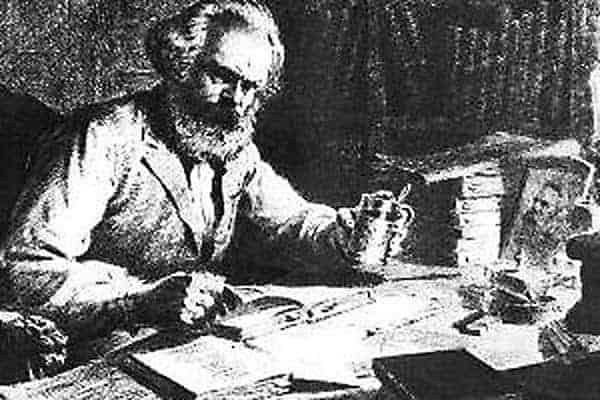
"Je ne suis pas un marxiste.", said Marx. Like Hamlet, the tragedy was that he knew would never be understood, try as he might. He was relentlessly coruscating in the corrections he issued - that barb was to his own son-in-law, Paul Lafargue, chief among the phrase-mongering French, where Marx saw his method of analysis being turned (already!) into a form of dogmatism. It took Marx some twenty years to produce his masterwork Das Kapital, from the initial research, though his 800-page Grundrisse foundational notebooks, to the "finished" text, that is, of Volume 1. With self aware irony, he referenced Balzac's story 'The Masterpiece' as he finally handed over the manuscript to Engels for the publishers, wherein the painter's constant reworking of his chef d'oeuvre obliterates it to all but his own eyes. With the maximalist's obsessiveness, Marx grappled with all available knowledge in the tradition of the universalist polymath, famously crediting England for its political-economy, Germany for its philosophy, France for its utopian socialism. His method could be called dialectical - or historical - materialism, and he is reluctantly included among the pantheon of western historians: that class struggle is a motive force in human history is a point of analytic departure none since can ignore. The short, sharp bullet of the Communist Manifesto is the most widely translated political text of all time. Almost a third of the world's population in 1980 lived under states claiming to be Marxist-Leninist. The place that Marx and the early Marxists earn on this course, is not just due to political legacy. They were deeply cultured people: Marx was a huge fan of Cervantes, Diderot and Sterne (who you'll see grouped together in the next section of courses) and even tried to emulate Sterne's style. He loved Shakespeare and Goethe, and saw his writing to be his life-work, an artist's labour. This literary predilection, the concern with cultural issues, characterises the generation that followed, but it is divided between the academy and the party today.
Oh, and his pedagogic stance: "The emancipation of the working class must be the task of the working class itself."
(But in case you’re missing the mark, some home-werk: what is Marx - posthumously - really saying when he talks about “educating the educator” in his Third Thesis on Feuerbach?)
1.6) 1922: Wandering Jews, Mourning, Melancholia, Penelope's Work & the Epic
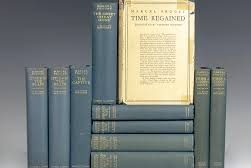
'The Remembrance of Things Past', C.K. Scott Moncrieff's English translation, was almost as lengthy a labour of love as Marcel Proust's original writing, fellow gays in the closet. Proust was a contemporary and rival of Joyce - the span of decades in A la recherche vs that of a day in Ulysses; an anatomy of the duchess vs undressing of the chambermaid.
In the same letter, September ‘22, Virginia Woolf said of Proust: "How at last, has someone solidified what has always escaped—and made it into this beautiful and perfectly enduring substance?" but of Ulysses that "Genius it has, I admit; but of the inferior water". Yet even her diary concedes four days later that "what I am doing is probably being better done by Mr. Joyce" and elsewhere that "he is concerned at all costs to reveal the flickerings of that innermost flame." And so in 1922, when Proust died, when Ulysses was published in Paris, and Jacob's Room and T.S Eliot’s ‘The Waste Land’ in London, there's poor Walter Benjamin based at home with his parents in Berlin, venturing out to Heidelberg to pursue his Habilitation and a love affair. He announced but was unable to launch Angelus Novus, a journal of literary criticism. A year of the most worthwhile projections and failures.
Benjamin, too, undertook the labour of translating Proust, the first to appear in German, though the manuscript of Sodome et Gomorrhe was lost or destroyed during his flight from the Nazis. "I must say that I am poisoned by it, and yet I also find in it a very significant schooling for my own work."
All four - Proust, Woolf, Joyce and Benjamin - looked back to Homer. The first edition of Ulysses was bound in "Aegean Blue" in homage to the Greeks - to the character whom Joyce declared "a complete man" in contrast to the other heroes of literature. Joyce also adhered to a theory that Homer was of Semitic stock, hence casting Leopold Bloom as a Jew. Woolf (married to a Jew but somewhat anti-Semitic) on the Greeks: " it is the solidity of their sorrow that strikes us. ... "It is a sorrow that has been clarified; it is not, as with us [moderns] mixed with a thousand other things"... For Benjamin, Homer represented a threshold, a paradise lost in the mode of storytelling when a story that could be told orally, in community. The novel, the book, was the product of the modern isolated individual for the consumption of the self-same reader…
In Benjamin's essay 'The Image of Proust': "the important thing for the remembering author is not what he experienced, but the weaving of his memory, the Penelope work of recollection. Or should one call it, rather, a Penelope work of forgetting? Is not the involuntary recollection, Proust’s mémoire involontaire, much closer to forgetting…” In ‘Excavation and Memory’: He who seeks to approach his own buried past must conduct himself like a man digging. Above all, he must not be afraid to return again and again to the same matter... which yields only to the most meticulous examination ... the real treasure hidden within." And back to the 'Image of Proust': "For here the day unravels what the night has woven"
Freud 1917 (via Riviere in English in 1924) "In mourning it is the world which has become poor and empty; in melancholia it is the ego itself."